

If your pickers keep returning to the same shelves for different orders, it’s worth looking at how those orders are grouped. Combining trips can save some walking around the warehouse, but someone still has to keep track of which items belong to which customer. That work might happen during the pick or afterward.
The right order picking strategy depends on what you ship, how your orders arrive, and where your team loses time. A method that works well for small, similar orders can create extra work when the items are bulky or every order is different.
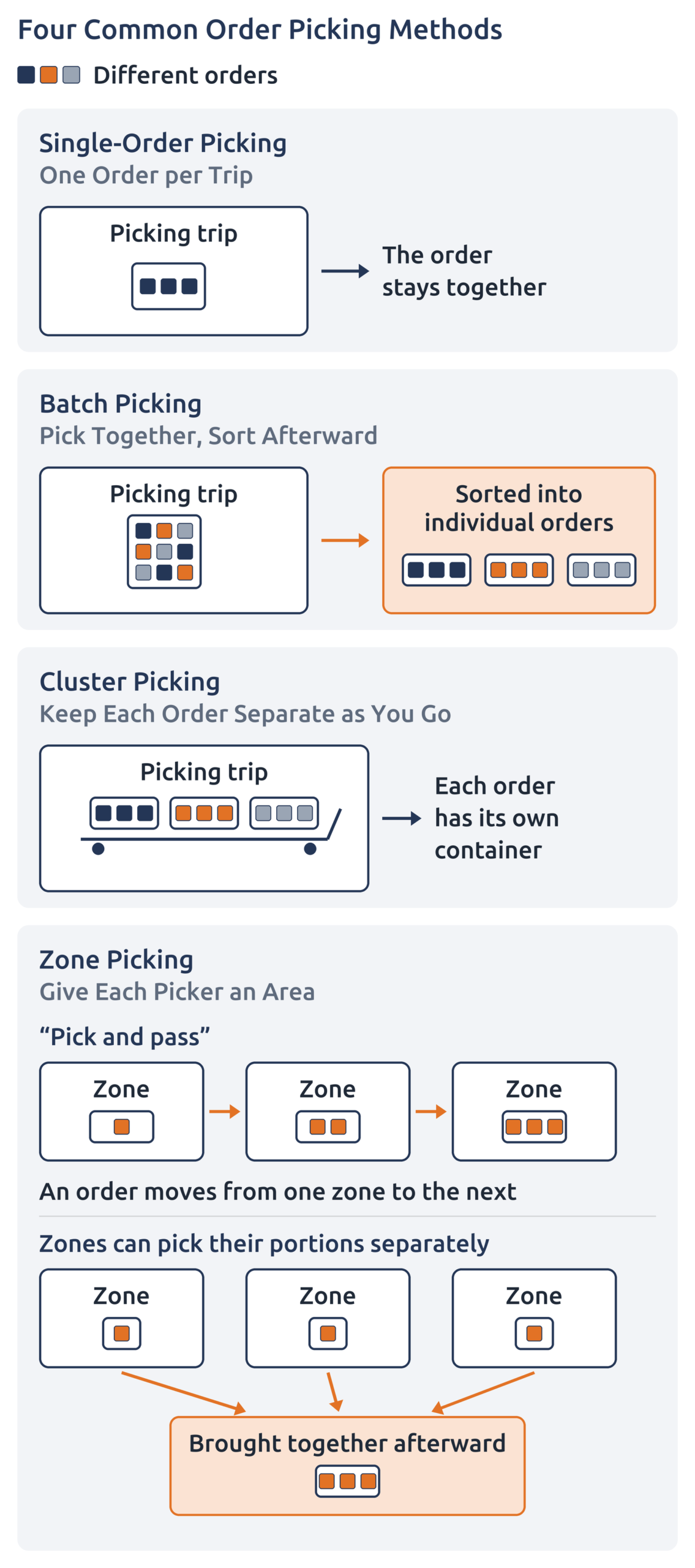
Four Common Order Picking Methods
Single-Order Picking: One Order per Trip
With single-order picking, a picker gathers the items for one customer order before starting the next. The order stays together, which makes the process straightforward to follow and avoids sorting a mixed collection of items into separate orders later.
This is a good choice when you have relatively few orders, orders with little in common, or items that need more room or careful handling. If one order already fills a cart, adding more orders to that trip won’t help.
The drawback is repeat travel. If several customers order the same item, your picker may visit its storage location several times. That becomes a bigger concern as the number of small orders grows. Before changing methods, check whether that walking is actually holding up shipments. If completed picks are already waiting for packing, faster picking alone won’t solve the delay.
Batch Picking: Pick Together, Sort Afterward
Batch picking brings several orders together for a picking trip. The picker collects the combined quantities, and the items are then sorted into individual orders.
Suppose a group of customers all order the same replacement part. Instead of making a separate trip for each customer, a picker can collect the quantity needed for the group in one visit. This is why batch picking is worth considering when many small orders share the same items or nearby storage locations.
The sorting step needs just as much thought as the trip. Where will it happen? Who will do it? Can that team keep up when orders are busiest? Walking less is useful, but the benefit can disappear if people spend that time sorting or correcting mixed-up orders.
Bigger batches aren’t automatically better. The combined items have to fit inside your carrying equipment and remain manageable. A batch that looks sensible on a pick list may be awkward once the cart fills up.
Cluster Picking: Keep Each Order Separate as You Go
Cluster picking also lets a picker collect several orders on one trip. Each order has its own container or compartment, so the picker separates the items as they’re picked.
Picture a cart with a clearly identified tote for each order. At a shared storage location, the picker puts the right quantity into each tote that needs the item. Those orders travel together but stay separate.
The difference from batch picking is when items are separated. Batch picking leaves a sorting task after collection while cluster picking builds it into the trip. That reduces sorting later, but it does add container checks and handling while the picker works.
Container space is a practical limit. Bulky orders can quickly use up the available room, and adding more totes gives the picker more order positions to track. Choose a manageable group of orders, with clear container identification before trying to put more work on each cart.
Zone Picking: Give Each Picker an Area
Zone picking divides the warehouse into areas, with pickers working in their assigned zones. They don’t have to cross the whole building to complete every order.
Orders that need items from several zones still have to come together. In a sequential “pick and pass” arrangement, an order moves from one zone to the next. Alternatively, zones can pick their portions separately and those items are brought together afterward.
Shorter routes can be appealing, especially when orders would otherwise send people across several storage areas. But the busiest zone can set the pace for everyone else. An order may be nearly complete and still wait because its last item comes from a backed-up zone.
We’d look at how much work each zone receives, how many people it needs, and how orders move between areas. Dividing the floor into equal sections doesn’t necessarily divide the work equally.
Where Wave Picking Fits
You’ll also hear the term wave picking. A wave is a group of orders released for picking together, often to meet a shipping cutoff or spread work across the day. It’s a scheduling choice that can work with the methods above.
For example, you could release orders due for a particular carrier pickup as one wave, then use zone picking to collect them. Or you could divide that wave into batches of similar orders. Cluster picking describes how orders stay separate during a trip; a wave controls when a group of orders becomes available to pick.
Wave size and timing matter because the work doesn’t end at picking. Releasing a large wave can leave sorting and packing with more work than they can handle at once. Waiting too long to release it leaves less time before the cutoff. Plan around what the whole team can finish, including the people handling the orders after picking.
Match the Method to Your Orders
Size alone won’t tell you which order picking process to choose. A large building can still have orders that make sense to pick individually. A smaller operation might have enough similar orders to benefit from combined trips.
Start with a sample of actual orders from ordinary days and busy periods. Your order profile is simply the pattern in that work. These details make it easier to compare warehouse picking methods:
- Order lines: How many separate items does each order contain, and how many units of each? A high order count can hide very different amounts of picking work.
- Shared items: How often do different orders need the same SKU, or item code? Frequent overlap gives you more reason to consider combined trips.
- Size and handling: Will the orders fit into separate totes, or do large, fragile, or awkward items need a different approach?
- Timing: Do orders arrive steadily, or does most of the work land close to a cutoff? Look at the busy hours as well as daily totals.
- People and space: Who is available to pick, sort, and pack? Where do orders wait, and which areas get crowded?
You don’t have to use one method for everything. Small orders with common items might work well in batches, while oversized orders continue one at a time. A useful choice fits the work your team handles, including the exceptions that make an average day less predictable than a report suggests.
Try the Change Before Expanding It
A small trial can show whether or not a new method helps your warehouse. Choose a manageable group of orders that reflects your normal work, then include a busy period or mix in high order volumes. Comparing a quiet morning under one method with a rush under another method won’t tell you much.
Give the team a clear explanation of the new approach and time to learn it. Make sure pick lists, order labels, and containers support the method you’re testing.
Follow the Order Through Packing
Look beyond how quickly the picker returns. Track time spent picking and traveling, along with sorting, waiting, and correcting mistakes. Check whether orders are complete and packed before their cutoff. Ask both pickers and packers what has become easier and what now takes more effort.
If batch picking cuts walking but leaves packers facing a growing pile of mixed items, try a smaller batch or a narrower group of similar orders. If one zone repeatedly falls behind, look at its workload and staffing. These results help you see what needs adjusting before you expand the method.
Account for the Work Needed to Change
Compare the ongoing labor with the effort needed to get started. New containers, revised pick lists, training, or changes to order release can all affect the decision. A method has to be practical for your team to use every day.
Technology is a related choice. A warehouse management system (WMS), scanners, or voice picking can help direct the work, but you still need to decide which orders to group and how to keep them separate. Check whether your current tools support the proposed method before making it part of the daily routine.
Get Help Choosing a Warehouse Picking Process
If you can see the repeated trips or backed-up orders but aren’t sure what to change, we can help assess your picking process and how materials move through the warehouse. Our warehouse consulting services support that assessment and planning. For a defined improvement project, explore our warehouse optimization services.
Tell us what your orders look like, where work gets held up, and what you need to work around, such as limited space, staffing, or shipping cutoffs. Those details give us a useful starting point for discussing your project.